

What Makes a Great Real Estate Agent [12 Traits and Skills]

The Vulcan7 Team
Share the Secrets


Summary
Great real estate agents focus on personal development and build skills that make them more effective at what they do every single day. You need to be confident, resilient, self-aware, adaptable, and open-minded with energy and enthusiasm when you’re prospecting and interacting with customers. Being able to embrace risk without freezing up and having a strong work ethic will help you build your business, as will knowing how to handle objections and actively listen to your customers.
| Details | Information |
|---|---|
| Time to Read | ~8-10 minutes |
| What You’ll Learn |
|
| Next Steps |
|
What Makes a Great Real Estate Agent [12 Traits and Skills]
Success in real estate doesn’t happen by accident. There are no quick fixes, shortcuts, or “get rich quick” secrets that will help you become a great agent overnight.
It takes hard work, dedication, resilience, and a strong mindset to make it in this business. And while some top-producing agents seem to have a natural talent for selling properties, the truth is that most of the key traits and skills you need can be learned, practiced, and refined over time.
In this guide, you’ll learn which traits to focus on if you want to succeed and how to develop them by making small adjustments to your day. We’ll also share helpful tips from real estate coach Justin Ford that can help you take your efforts to the next level.
How Vulcan7 Can Help You At Every Step
The right tools take a lot of the friction out of building a real estate career. Vulcan7 gives you the leads, software, and support you need to focus your time on the work that actually grows your business.
When you become a member, you get:
- The industry’s best, most accurate leads, starting with newly expired and FSBO leads delivered each morning to your desktop.
- Access to a user-friendly, highly intuitive CRM that helps you stay on task during every phase of your business transactions.
- An engaging, supportive community of like-minded agents who share tips and celebrate successes, starting with our weekly ROADMAP video series.
Whether you’re looking to become the type of real estate agent you want to be, or you need to hone your skills, making Vulcan7 a part of your pipeline can help you get there faster.
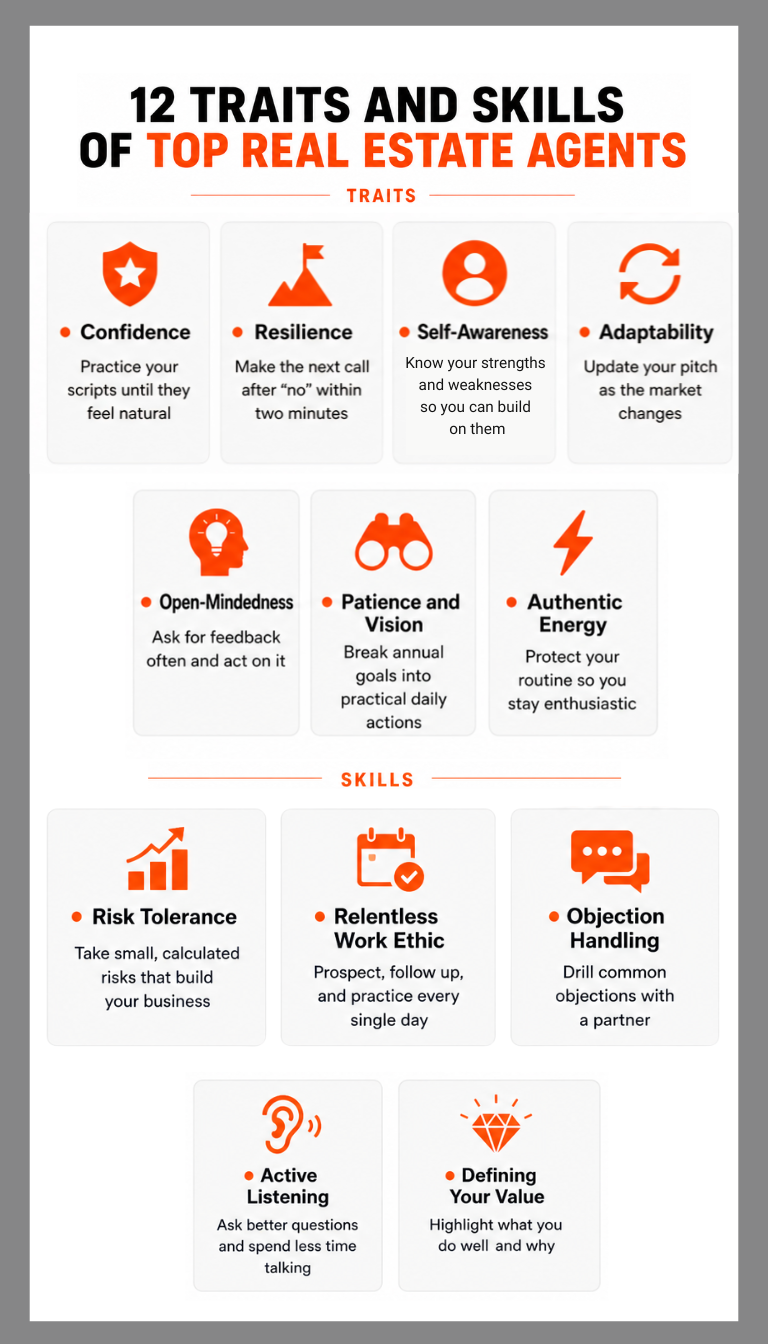
Traits
Your traits are what you bring into the room before you say a word. They show up in how you handle a tough listing appointment, how you take a “no,” how you carry yourself on a cold call.
1. Confidence
We all know that one agent who walks into a room and instantly draws every eye to the front. That kind of authority is one of the defining qualities of a successful real estate agent, but you don’t need to be born with it. You can develop it by knowing your subject matter inside-out.
To become an expert, you need to:
- Study your market weekly. Pull recent comps, track inventory shifts, and review days-on-market data so you can speak to conditions from both the buyer’s and seller’s perspective.
- Rehearse your listing presentation until it’s automatic. Roleplay with a partner each morning. Time yourself and ask for feedback until it’s practically instinct.
- Show up looking the part. Dress for success, keep your car clean, and treat every appointment like the consummate professional you want to become.
- Drill your scripts daily. When you’ve internalized the words, you stop thinking about what to say and start focusing on what the prospect actually needs. This will help reduce any anxiety.
There’s a fine line between exuding confidence and coming off arrogant, and part of your job is knowing where that line sits. Plant your feet firmly on the side of authentic confidence and you’ll win every time.
2. Resilience
Rejection is part of the job. Deals fall through, clients change their minds, and leads don’t always convert. The agents who last are the ones who can take a “no” and pick up the phone again two minutes later, and this isn’t always easy for everyone.
Real estate coach Justin Ford recommends “expecting the no” as a mental framework for prospecting. By assuming that rejection will happen, you free yourself to keep dialing without flinching.
You can build resilience the same way top producers do:
- Reframe rejection as data, not defeat. When a homeowner says no, log the objection and move to the next call instead of replaying the conversation in your head.
- Debrief your tougher calls at the end of the day. Spend 10 minutes asking what went wrong and what you’d do differently, then close the notebook and leave it there.
- Set a recovery rule. Commit to making your next call within two minutes of a hard no, before the sting has time to settle in. The more calls you make, the easier it gets.
- Track your numbers honestly. Rejection feels different when you can see that every “no” moves you statistically closer to a “yes.”
Justin breaks down his approach to building a bulletproof mindset in the full Coaches and Mentors episode below:
3. Self-Awareness
Some agents excel at being persuasive, while others can sit at their desk for hours without being distracted. Being honest with yourself about what you do well now, and what you need to work on, is what separates the agents with a growth mindset from those who stagnate.
You build self-awareness by reviewing your performance regularly:
- After listing appointments, ask what worked and what didn’t
- Track your prospecting calls and look for patterns over time
- Work with a coach or accountability partner who can catch the blind spots you’ll miss on your own
Part of self-awareness is recognizing your limiting beliefs and working past them rather than letting them set your ceiling. Every time you catch yourself thinking “I can’t do this,” question whether it’s actually true or flip it into a “yet” statement: “I can’t do this yet because I need to practice my objection scripts.”
4. Adaptability
The market never stops moving, and if you want to succeed, you need to keep up with it—but not everyone will. Hundreds of agents have left the industry in the past few years because they didn’t understand how to adapt or just didn’t want to invest enough time honing their seller skills.
To stay ahead of the pack, you need to be:
- Tracking market shifts in real time. Monitor inventory, rate changes, and policy updates like the NAR settlement so you can speak to them on every call.
- Adopting new tools before you’re forced to. Test new CRMs, dialers, and prospecting platforms early so you have an edge when the rest of the market catches up.
- Adjusting your pitch when conditions change. Rework your scripts and presentations to address whatever objections the current market is generating.
Treat every market shift as a learning opportunity rather than a threat, and adaptability becomes second nature. You’ll also build new skills that give you a serious advantage.
5. Open-Mindedness
Open-mindedness is what makes adaptability possible. Without it, you stay stuck doing things the way you’ve always done them, even when it stops working. It’s okay to admit you don’t have it all figured out yet (or anymore)!
If you’re noticing friction in this area, it can help to:
- Seek out mentorship and training. Find a coach or join a mastermind group with agents who are further along than you, and actually take their feedback.
- Ask for help when you’re stuck. A struggling listing or a stalled pipeline isn’t a sign you should figure it out alone, it’s a signal to reach out.
- Audit your own assumptions regularly. Once a quarter, ask yourself which of your “rules” about the business might actually be limiting beliefs in disguise.
Keep in mind that every agent goes through these feelings at some point. It’s just part of the experience of working in real estate.
6. Patience (and Vision)
New agents tend to want results yesterday, but real estate is a marathon, not a sprint. The best agents understand that long-term consistency is what produces lasting results, and they build systems that keep them moving forward when the wins feel far off.
You can cultivate patience and long-term thinking by:
- Reverse-engineering your annual goal. Set a target for the year, then break it down into quarterly listings, monthly appointments, weekly calls, and daily follow-ups.
- Tracking small wins as proof of progress. Log every appointment booked, every objection handled cleanly, and every referral request, so you can see momentum even in slow months.
- Building a market-downturn playbook. Have a written plan ready (which scripts to lean on, which lead sources to double down on, which expenses to cut) so you can adapt instead of panic.
A clear long-term vision strips short-term setbacks of their power to derail you. It’s all about setting yourself up for success in the future as well as the now.
7. Authentic Enthusiasm
You don’t need to walk in like a cheerleader on a fall Saturday, but a little energy goes a long way. Flip the tables for a second. If you were the seller, who would you rather hand your listing to, an outgoing and personable agent or one who knows their stuff but bores you to tears?
Bringing genuine energy to every appointment takes a bit of work behind the scenes:
- Protect your sleep and your morning routine. Energy on a 7 PM listing appointment starts with how you treated your body that day, so build the basics in before you need them.
- Schedule appointments when you’re actually at your best. If you’re sharper in the morning, stop booking 6 PM listing presentations you’ll show up to drained.
- Audit what’s draining you. Once a month, look at the appointments and tasks that left you flat, and figure out whether to delegate, restructure, or eliminate them.
Just make sure when you bring that energy, it’s genuinely yours, because clients can read through an act in about thirty seconds. Lean into what actually interests you about the work instead of performing.
Skills
People choose you based on how you make them feel, and how you make them feel comfortable and confident in you by knowing what to say, and that’s where our skills come in.
-Justin Ford
Skills are where the traits earn their keep. The good thing about skills is that they’re teachable and measurable, which means anyone willing to put in the practice can develop them.
8. Risk Tolerance
Real estate is a business of calculated risks, and knowing how or when to take them is indeed a skill. Top agents aren’t afraid to step out of their comfort zone. In fact, many came from other industries before taking the leap because they wanted more control over their careers.
To build tolerance for risk without putting yourself in danger, start small. Make one investment in your business this quarter that scares you a little, then track the outcome.
As time goes on, try your best to:
- Leave stability for greater opportunities when the math makes sense
- Invest in yourself and your business financially and time-wise
- See failures as lessons instead of roadblocks
A track record of taking risks and surviving them makes the next decision easier. It’ll also help you build your confidence, which can positively influence every element of what you do daily.
9. Relentless Work Ethic
Real estate is competitive, and the most successful agents know that hard work is non-negotiable. They show up every day, follow a strict routine, and put in the effort even when they don’t feel like it.
The work ethic of a top agent shows up in three places:
- Script and presentation mastery through consistent practice
- Daily prospecting because lead generation is the foundation of everything else
- Relentless follow-up because relationships are what turn one deal into ten
The agents who win aren’t always the most talented in the room. They’re the ones willing to put in the work when nobody’s watching.
10. Objection Handling
Knowing how to handle objections keeps your conversations and your deals on track when they would otherwise fall apart. It’s one of the most teachable skills in the business, and the agents who master it stand out fast.
Justin and his team play a game called “Stump the Chump.” He sits surrounded by a circle of team members, who pepper him with standard (and maybe not-so-standard) homeowner objections. The goal is to stump Justin.
Justin claims he’s never been stumped:
“There’s not an objection that they can throw at me that I don’t know how to overcome because I work with objection scripts.”
You can build the same skills by:
- Finding a role play partner and run objection drills regularly
- Working from a script library until your responses feel natural
- Adding new objections to your library every time a homeowner throws a new one at you
The more comfortable you get with objections, the more confidence you project on real calls.
11. Active Listening
You’re in business to earn a living, but putting the client’s needs first is what actually gets you there. Never forget that you’re in the SERVICE business, and that means working to build trust even when it costs you longer hours.
Active listening is the foundation of that trust:
- Ask open-ended questions and let the client finish before you respond
- Take notes on what they actually said rather than what you assumed they meant
- Talk less on your next five appointments and watch what changes
Add value to the relationship beyond the transaction itself. Help clients plan their finances, or connect them with someone who can if they’re not in a position to make an immediate down payment. Once you’ve made the sale, stay in touch.
12. Defining Your Value
Think of your value proposition like a mission statement. Putting your value into words is useful for you, since it lets you remind and refocus yourself, and it also clarifies in one short sentence what you offer that no other agent does.
To define it, ask yourself:
- Do you offer something different? That might mean providing professional photography, covering pre-inspection expenses, or offering staging advice.
- Can you be viewed as an authority figure? Maybe you’re the go-to expert in a certain part of your MLS. Lean on your knowledge of the neighborhood to set yourself apart.
Once you’ve nailed down what makes you unique, your value proposition becomes the through-line for every conversation, listing presentation, and marketing piece you produce.
Bring It All Together With Vulcan7
The agents at the top of the leaderboard aren’t working from a secret formula. They’ve spent years building the traits that keep them in the game and sharpening the skills that close the deals, and they’ve surrounded themselves with the right tools to make all of it easier.
That’s where Vulcan7 comes in. Our industry-leading lead data, built-in dialer, and CRM give you the foundation to put your traits and skills to work every single day, so you can spend less time chasing and more time closing. Become a Vulcan7 member today and start turning who you are into what you close.
RECOMMENDED ARTICLES

How to Approach a FSBO as a Realtor
Updated June 2026 Summary To approach a FSBO as a…

How to Win the Highest-Opportunity Days of the Year: Inside the Vulcan7 Real Estate Prospecting Bootcamp
Every year, thousands of real estate listing contracts expire at…

What to Do After Closing: Best Tips for Cultivating Customer Relationships in Real Estate
You handed over the keys, wrapped up the paperwork, and…