

How to Overcome Call Reluctance

The Vulcan7 Team
Share the Secrets


Summary
Call reluctance affects 98% of real estate agents, creating a paralyzing fear of phone prospecting. This guide reveals six proven strategies to overcome it: reframe your role as a counselor, build accountability partnerships, record and review your calls, embrace rejection as proof of effort, manage stress with morning routines, and celebrate small wins. Learn why fear of rejection is biological, identify the warning signs of call reluctance, and discover how the right tools and mindset can transform your prospecting confidence.
One of, if not THE biggest, barrier to success in real estate is call reluctance. For some agents, it can be a paralyzing fear of calling someone cold. Call reluctance is common for sellers in any industry, but tends to be incredibly pervasive in real estate, where success is driven by continuous, dedicated phone prospecting.
It’s estimated that only 1-2% of real estate agents actively phone prospects on a regular basis. That means 98% of agents passively prospect, sending out flyers, waiting for calls to come in, writing an occasional letter. Of course, the silver lining to this statistic is that there is tremendous upside potential for any real estate agent who overcomes call reluctance and becomes a transaction-building machine.
In this post, we will discuss call reluctance and provide helpful tips that can help you overcome this mental block and get on the path to the best success of your career.
What Is Call Reluctance?
A Scientific Explanation
According to CIENCE, call reluctance syndrome, also known simply as call reluctance, is a “psychological phenomenon where salespeople experience a fear to reach out to prospects and make phone calls. This situation is most typically observed at the start of a potential customer relationship referred to as cold calling.”
As the chart below shows, call reluctance can have a major impact on a seller’s career regardless of their experience level:
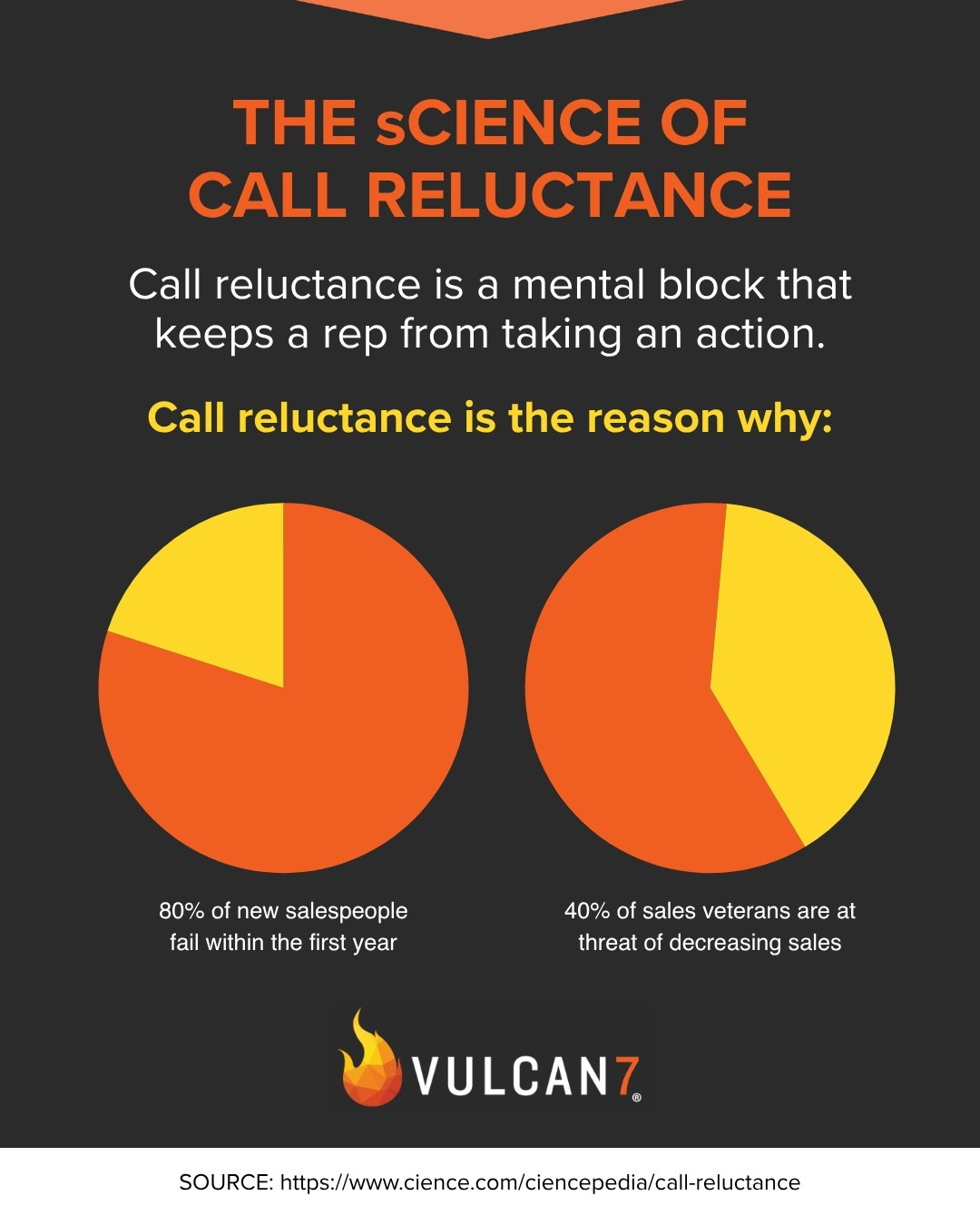
SOURCE: https://www.cience.com/ciencepedia/call-reluctance
Maybe the best place to start is with a reality check: every real estate agent, even those playing at the top of their game, has experienced the anxiety of call reluctance at some point in time. So, you’re not alone.
Here’s the one thing you need to remember: you’re not alone. Every real estate agent, even those at the top of their game, has experienced call reluctance at some point. Everyone knows the feeling. You get up early, determined that today’s the day you’ll turn things around. You sit at your computer, put on your headset, log on to Vulcan7, hover your cursor over the dialer, and… Freeze! You’re unable to move forward, to make that call. Your stomach tightens, anxiety sets in. You decide that a second cup of coffee would be a good thing to get your mind focused. And so, it goes!
What Leads to Call Reluctance?
There are myriad reasons why agents shy away from picking up the phone. Let’s look at four of the biggest reasons:
Fear of Rejection
This is the mother of all call reluctance factors. Humans are hardwired as a species to seek positive group interaction, acceptance, and approval. This hard-wiring runs counter to the nature of real estate prospecting, when you often (especially these days) sit in an office, alone, for hours on end, not getting that group acceptance you need. As such, the thought of rejection, in any form, precipitates a biological fear response that ultimately urges us to retreat to a safe place, such as our Facebook feed.
Using Unqualified Leads
If you’re not working with a proven lead/CRM system, like Vulcan7, you’re likely making true “cold calls” to people who may have little interest or urgency to sell, let alone talk to a real estate agent. It’s difficult to feel confident if you’re working with second-rate information.
You’re Uncertain of Your Value Proposition
Put another way, you aren’t fully comfortable with the product (“YOU”) you are trying to sell. Or, perhaps more dramatically, you question your purpose as an agent at a deep level. Both of these factors fuel a certain kind of insecurity that makes the idea of phone prospecting daunting in the extreme.
You Haven’t Practiced Enough
Surely, you’ve heard about the 10,000-hour principle, whereby you need to spend 10,000 hours to be great at any enterprise. Clearly, you don’t need to spend 10,000 hours to become a top-performing agent, but it’s difficult to have the confidence to dive into phone prospecting if you aren’t working at your craft all the time.
Are You Suffering from Call Reluctance Syndrome?
Here Are the Signs to Consider
Again, we’ve all been there. But here are a few outward behaviors indicating that you might be suffering from a chronic case of call reluctance:
Procrastination: Why do today what you can put off until next week? “I’ll call after I check my Facebook feed… for the 5th time today.” This is the biggie, and the primary challenge to anyone who has to sell to make a living. Procrastination is linked to dread over a task you really don’t want to perform. Procrastination is a pesky foe because it can easily manifest in behaviors that we can easily justify as productive, even important: checking email, scrolling through our social media sites to see if anyone has engaged with our new-listing post, etc.
Over-preparation/over-analysis: Put another way, “paralysis by analysis,” when you convince yourself that you’ll have the answer to every conceivable question. It’s easy to become bogged down by over-preparing to make every call. Perhaps you’re preparing to call a new expired listing. You might spend more time than is necessary studying the file, looking at the previous listing, and immersing yourself in the details so that your confidence can bring insight to the call (instead of bringing the real you).
Anxiety or Nervousness: You exhibit physical symptoms before picking up the phone, such as sweating, a racing heart, or dry mouth.
Negative emotions and self-talk: Some might refer to this as “stinking thinking.” It’s the endless chatter about the future that fills us with dread, anxiety, or even debilitating panic attacks. The more incessant the chatter, the more likely it is you’ll find reasons to procrastinate in order to avoid (or suppress) the negative feelings.
Making Excuses: You continuously have an excuse for not making your calls (“I was busy this morning, so I’ll call in the afternoon.”)
Comparing Yourself to Others: This can be another version of negative self-talk when you convince yourself that “they” are doing a much better job than you, which makes you feel even more inadequate.
Overcoming Call Reluctance: 6 Proven Strategies
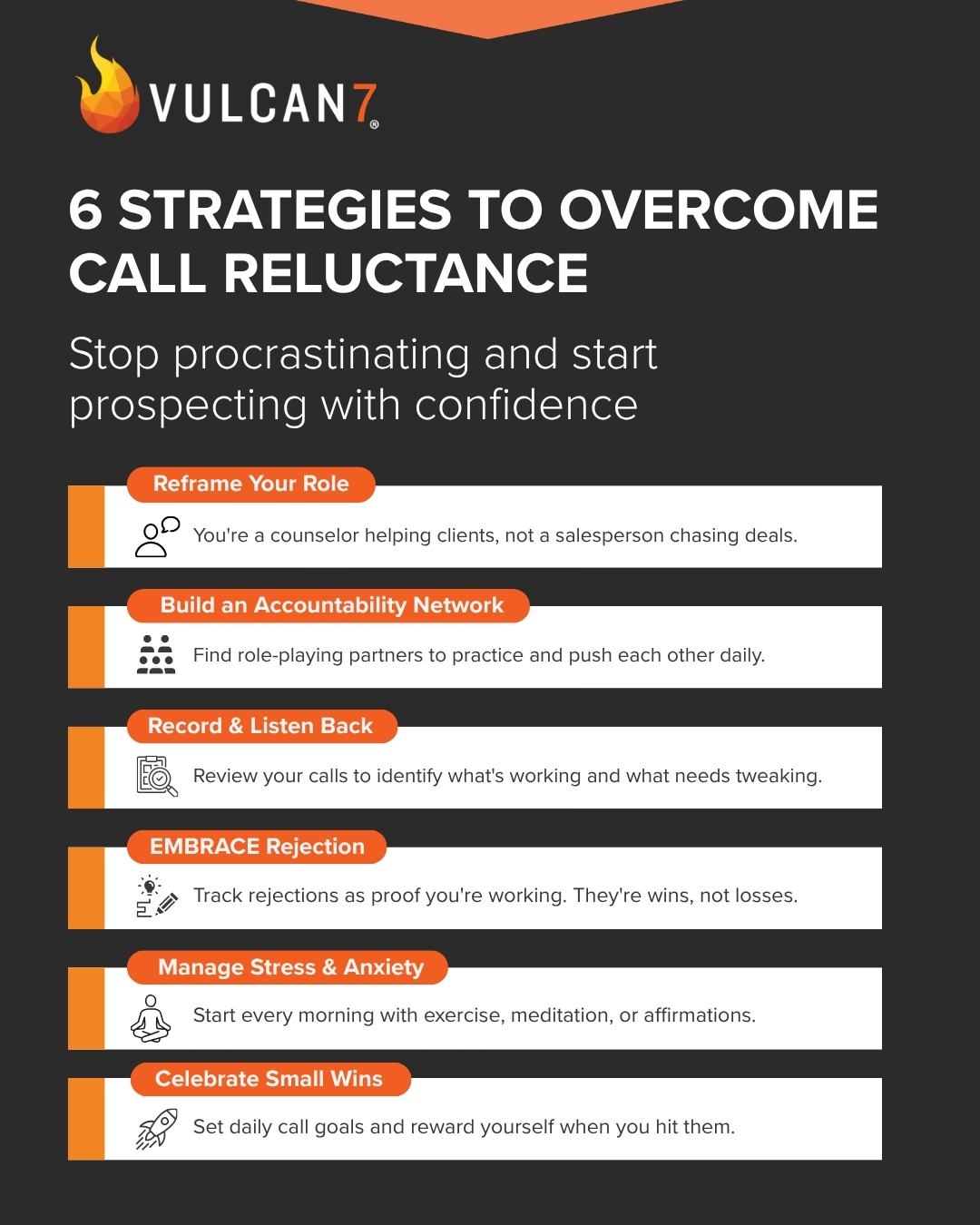
You can’t just “will yourself” to overcome call reluctance. But you can power through it by taking important steps to approach your business. Here are six strategies to help get you on track:
Reframe Your Role
Don’t think of yourself as a salesperson. Your role is to help guide your clients through one of the most important activities of their lives. They are anxious and often fearful. Take solace in knowing you are helping them realize their dreams.
You are:
- A counselor
- A problem-solver
- A friend
Shifting your perception can begin to have a dramatic impact on your outlook.
Build an Accountability Network
You can’t do this alone! Find role-playing partners and push each other before you start prospecting each morning, especially when handling objections. Role-playing will energize you and help to build up your confidence.
Record Yourself and Listen Back
It’s helpful to listen to yourself and determine how to tweak your delivery to be even more effective. Record your phone prospecting efforts and play them back to identify areas for improvement.
EMBRACE Rejection
Many top-performing real estate professionals use rejection as a goal. They gauge the success of their phone prospecting efforts by the number of rejections they get. Indeed, those rejections are proof-positive that they are working the phones to the fullest. Or, to borrow from hockey legend Wayne Gretzky: “I miss 100% of the shots I DON’T take.”
Manage Stress and Anxiety
Exercise, meditation, affirmations, it doesn’t matter what works for you, but try to start every morning with activities that help to steel you for the day ahead.
Examples:
- Morning workout routine
- 10-minute meditation practice
- Positive affirmations before dialing
- Breathing exercises
Celebrate Small Wins
Set a manageable goal of making a certain number of daily calls. When you reach that goal, reward yourself by:
- Taking a break
- Streaming something on Netflix
- Taking a walk with your kids
Remember: success begets success, so celebrate every win, no matter how big or small.
Vulcan7’s Answer to Call Reluctance
Use Your Tools
Call reluctance is a real psychological malady that can impact your real estate prospecting efforts. The previous section outlined six steps to help you work through call reluctance syndrome.
But there’s a 7th step that can dramatically impact your ability to work through call reluctance and profoundly affect your career: EMBRACE TECHNOLOGY, such as VULCAN7!
Vulcan7 is the leading real estate lead generation platform in the country. Here are five ways Vulcan7 can complement the steps above in helping you manage call reluctance:
-
- Call with Confidence: Vulcan7 is known for superior leads and the most accurate data in the industry. Every morning, we deliver the most accurate contact information for Expired Listings, FSBOs, and FRBOs to your desktop.
- Stay Organized: Vulcan7’s simple-to-use CRM (Customer Relationship Management) software lets you stay focused and on-task when following up with prospects.
- Use Proven Scripts: Use your real estate scripts to guide your phone prospecting efforts. Scripts may be the most important tool you have to power through call reluctance.
- Join the Community: Weekly skills-building webinars, like Vulcan7 Roadmap and Take 52, provide tips from many of the industry’s top-producing agents. It’s also a great place to share ideas and celebrate wins with fellow agents.
- Get Expert Support: Starting with your onboarding process, you’ll be tapped into Vulcan7’s industry-leading support team, who will keep you on task… and confident.
It takes dedication, perseverance, and courage to be a top-performing real estate agent. It also takes acceptance that call reluctance affects most agents at some point in their real estate prospecting careers. But as we’ve outlined above, you can manage call reluctance and power through to reach your sales goals. And we’ll be here to help. GIVE US A CALL
RECOMMENDED ARTICLES

How to Approach a FSBO as a Realtor
Updated June 2026 Summary To approach a FSBO as a…

How to Win the Highest-Opportunity Days of the Year: Inside the Vulcan7 Real Estate Prospecting Bootcamp
Every year, thousands of real estate listing contracts expire at…

What to Do After Closing: Best Tips for Cultivating Customer Relationships in Real Estate
You handed over the keys, wrapped up the paperwork, and…