

How to Nurture Real Estate Leads

The Vulcan7 Team
Share the Secrets


Summary
Real estate lead nurturing transforms prospects into clients and referral sources through strategic relationship building. Learn how to provide exceptional service from day one, specialize in your ideal client type, and respond to referrals within 24 hours. Discover proven strategies for maintaining consistent communication, creating valuable educational content, and leveraging events to deepen relationships. Master systematic follow-up schedules, multi-channel touchpoints, and metrics tracking to build a sustainable business fueled by long-term client relationships and referrals.
| Time to Read | ~ 7 minutes |
| What You’ll Learn |
|
| Next Steps |
|
Many of us in the real estate business have heard that it’s easier to keep current customers happy than to find new customers. In fact, referrals are the mother’s milk of almost any business, but certainly so in real estate.
Despite that, few professionals receive enough training and guidance on nurturing and retaining our clients and leveraging them for referrals. More emphasis is on lead generation (and to be clear, that’s important) than on keeping our sources of referrals satisfied. Let’s examine proven strategies for cultivating referrals because when they are happy, they will generate more business for you.
What Is Real Estate Lead Nurturing?
Real estate lead nurturing is the process of building and maintaining relationships with potential clients throughout their buying or selling journey. Unlike immediate lead conversion, nurturing focuses on staying top-of-mind with prospects who may not be ready to transact today but will be in the future.
Lead nurturing transforms cold prospects into warm leads, warm leads into active clients, and past clients into referral sources. To successfully nurture leads from the top of your funnel to the bottom, you need to be consistent in your communication, value delivery, and relationship-building over weeks, months, or even years.
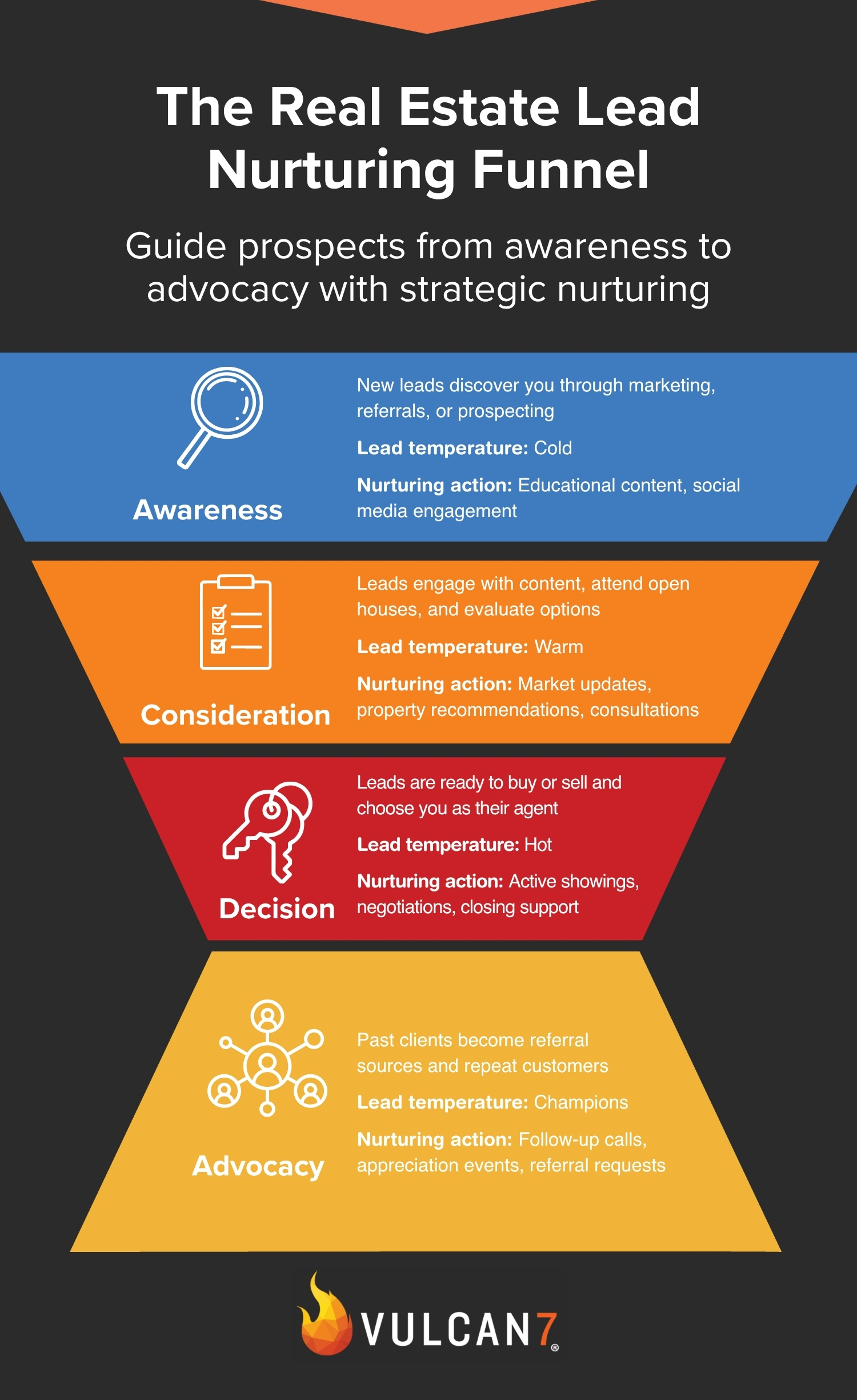
The marketing funnel shows you how leads move from the awareness stage to the conversion stage:
- Top of Funnel (Awareness): New leads discover you through marketing, referrals, or prospecting.
- Middle of Funnel (Consideration): Leads engage with your content, attend open houses, and evaluate their options.
- Bottom of Funnel (Decision): Leads are ready to buy or sell and choose you as their agent.
- Post-Transaction (Advocacy): Past clients become referral sources and repeat customers.
Effective lead nurturing guides prospects through each stage of this funnel.
10 Proven Lead Nurturing Strategies
1. Provide Exceptional Service From Day One
Nothing sells like success. When you close a sale, you should view that customer not only as money in the bank now but also as your best source of referrals down the road.
Example: Sarah, a top-producing agent in Austin, provides every client with a comprehensive “Welcome Home” package at closing that includes a year home warranty, local restaurant gift cards, and a personalized home maintenance calendar. She follows up at 30, 60, and 90 days post-closing to ensure her clients are settling in well.
Creative closing gift ideas:
- Framed historic local maps
- Personalized doormats or house number plaques
- Gift cards or certificates to local small businesses
- Smart home devices (doorbell cameras, thermostats)
- Local artisan gift baskets
It’s important that you continue to follow up with a client long after the deal is wrapped to see how they are enjoying their home.
2. Know Your Customer and Specialize
Many agents focus on one type of client, whether it first-time homeowners or couples wanting to downsize. Doing it this way allows you to become an expert in what this type of client needs, enabling you to target your services more effectively.
Example: Mike specializes in first-time homebuyers in Seattle. He’s created a comprehensive “First-Time Buyer Bootcamp” email series that educates prospects on mortgages, inspections, and the buying process. This positions him as the go-to expert before prospects even schedule a consultation.
Specialization benefits:
- Deeper understanding of specific pain points
- Tailored marketing messages that resonate
- Better resource recommendations (lenders, inspectors)
- Stronger reputation in your niche
3. Respond to Referrals Immediately
When a client or former client refers someone to you, time is of the essence. Follow up promptly to prove you value the relationship. Slow response may cost you the current referral and future referrals from your past client.
Example: Jennifer has a “24-Hour Referral Rule.” She contacts every lead that was referred to her within a 24 hours timeframe, even if it’s just to schedule a longer conversation. Then, she immediately sends a handwritten thank-you note to the referring client, and follows up after the first conversation to share how it went.
Immediate response checklist:
- Contact the referred lead within 24 hours
- Send a thank-you note to the referrer
- Update the referrer on the outcome
- Track referral sources in your CRM
4. Maintain Consistent Communication
Referrals might not necessarily translate into instant sales for you, but that doesn’t mean you shouldn’t keep in touch. Make sure your e-mail list is up-to-date so you can continue to communicate with clients and possible referrals.
Example: Tom sends a monthly market update email that discusses neighborhood sales data, new listings in the area, and local community news. He also sends out a quarterly print newsletter to past clients and top prospects, so that he reaches even those who prefer physical mail.
Communication frequency guide:
- Past clients: Monthly email + quarterly physical touch
- Warm leads: Bi-weekly email + monthly phone check-in
- Cold leads: Monthly educational content
- Sphere of influence: Quarterly updates
5. Create Valuable Educational Content
Position yourself as a trusted advisor by sharing knowledge that helps potential and current leads make informed decisions, even if they’re not ready to work with you immediately (and post it on social media, not just through emails!).
Example: Rachel creates short videos for YouTube and TikTok on topics like “Understanding Your Home Inspection Report,” and “5 Red Flags to Look for When Viewing a Property.” She shares these via email and on her social media channels, generating engagement at all stages of the funnel.
Content ideas:
- Market trend reports
- Home maintenance tips
- Mortgage rate updates
- Neighborhood guides
- Buying/selling process explainers
6. Leverage Events for Relationship Building
Invite potential clients as well as your best sources of referrals to special events (got a table at a local charity or non-profit event? Invite your prospects!) and share community news with them.
Example: Lisa hosts quarterly “Coffee & Market Updates” events at a local café where those who attend (usually past clients and prospects can network, ask questions, and get market insights in a casual setting. She also sponsors a Little League team and invites clients to games throughout the season.
Event opportunities:
- Client appreciation events
- Educational seminars (first-time buyer workshops)
- Charity fundraisers
- Open house networking events
- Holiday gatherings
7. Implement a Systematic Follow-Up Schedule
Create a structured follow-up system that ensures none of your leads ever falls through the cracks. Use your CRM to automate reminders and track your interactions.
Example: David uses Vulcan7’s CRM to categorize leads into “Hot” (ready now), “Warm” (3-6 months), and “Cold” (6+ months). Each category triggers different follow-up cadences: hot leads get daily contact, warm leads get weekly contact, and cold leads get monthly educational emails.
Sample follow-up schedule:
- Day 1: Initial contact and introduction
- Day 3: Share relevant listings or market data
- Week 2: Educational content delivery
- Month 1: Check-in call or coffee meeting
- Quarterly: Market update and value touch
8. Ask for Referrals (and Make It Easy)
One thing that many agents tend to forget is that if they don’t ask for referrals, they probably won’t get them. Don’t just assume your clients, friends, and neighbors know you’re looking for business.
Example: After closing a sale, Marcus sends a “Referral Request” email to his client that includes his business cards, social media links, and a simple referral form that they can send to people they know who might be in the market to buy or sell. In the email, he jsut says, “I grow my business through referrals from happy clients like you. If you know anyone considering buying or selling, I’d be grateful for an introduction.”
Even better, when getting referrals, ask for an in-person meeting over coffee so you can get connected by someone who knows both you and your prospective client.
How to ask:
- At closing: “I’d love to help your friends and family too.”
- In follow-up emails: Include a referral request signature
- On social media: “Know anyone looking to buy or sell?”
- Incentivize: Consider referral appreciation gifts
9. Use Multi-Channel Touchpoints
Don’t rely on just email or just phone calls. Use a mix of communication channels to stay top-of-mind and reach leads where they’re most comfortable.
Example: Amanda uses a multi-channel approach for her top 100 prospects that includes monthly email newsletters, quarterly handwritten postcards that feature recent sales, bi-annual phone calls, social media engagement (commenting on their posts), and annual holiday gifts.
Channel options:
- Email marketing
- Phone calls and text messages
- Direct mail (postcards, newsletters)
- Social media engagement
- Video messages
- In-person meetings
10. Track and Measure Your Nurturing Efforts
Monitor which nurturing activities generate the best results so you can double down on what works and eliminate what doesn’t.
Example: Kelly tracks every single lead source, touchpoint, and conversion in her CRM. By doing so, she discovered that leads who attended her educational webinars converted 3x more often than those who only received emails, so she increased her webinar frequency from monthly to weekly.
Key metrics to track:
- Lead source and quality
- Time from first contact to conversion
- Number of touchpoints before closing
- Referral rate from past clients
- Response rates by communication channel
- Cost per lead by nurturing method
The Long-Term Mindset
Finally, remember quality is always better than quantity, and a number of excellent referral sources take time to build. Treat your best referral sources with excellent care, but continue to court all potential sources, and with time, they will likely pay off.
Effective lead nurturing isn’t about quick wins; it’s about building a sustainable business through relationships that last for years. The prospects you nurture today become the clients and referral sources that fuel your business tomorrow.
RECOMMENDED ARTICLES

How to Approach a FSBO as a Realtor
Updated June 2026 Summary To approach a FSBO as a…

How to Win the Highest-Opportunity Days of the Year: Inside the Vulcan7 Real Estate Prospecting Bootcamp
Every year, thousands of real estate listing contracts expire at…

What to Do After Closing: Best Tips for Cultivating Customer Relationships in Real Estate
You handed over the keys, wrapped up the paperwork, and…