


How to Improve Real Estate Email Marketing
Summary:
Real estate email marketing improves when agents stop sending generic messages and start tailoring outreach to specific lead types. Expired listings, preforeclosures, FSBOs, investors, and circle prospects each respond better to different subject lines, offers, and follow-up timing. Stronger results usually come from cleaner lists, clearer welcome emails, shorter copy, useful attachments, and simple calls to action. When emails feel timely, relevant, and personal, they are more likely to build trust, generate replies, and create future listing opportunities.
| Summary Data | Details |
|---|---|
| Time to Read | ~8–10 minutes |
| What You’ll Learn |
|
| Next Steps |
|
How to Improve Real Estate Email Marketing
Email marketing is still one of the most reliable ways for real estate agents to stay visible, build trust, and create more listing opportunities over time. But simply sending emails is not the same as using email well. Weak subject lines, generic messaging, poor list hygiene, and inconsistent follow-up can quietly drag down your response rates and hurt your credibility.
The good news is that most of these problems are fixable. Better real estate email marketing usually comes down to a few fundamentals: sending the right message to the right people, setting expectations early, keeping your database clean, and writing emails that feel relevant instead of mass produced. When you do that consistently, email becomes less of a box to check and more of a real prospecting channel.
Why Real Estate Email Marketing Still Matters
Most real estate contacts do not convert after a single interaction. Sellers compare options. Homeowners wait until their timing is right. Investors watch the market. Neighbors may not need an agent today, but they may remember the one who consistently showed up with useful information.
That is where email helps. It gives you a way to stay in front of people without needing to call every contact every week. It also helps you build familiarity at scale, especially when your messaging matches where someone is in their decision-making process.
Used properly, email can help you:
- Stay top of mind with past and future sellers
- Build trust before a call ever happens
- Reinforce your market expertise
- Create repeat touchpoints without sounding pushy
- Support your calling, texting, and direct mail efforts
- Nurture colder leads until they become warmer opportunities
Start With the Right Goal for Each Email
A lot of real estate emails underperform because they try to do too much at once. Before writing anything, decide what the email is supposed to accomplish.
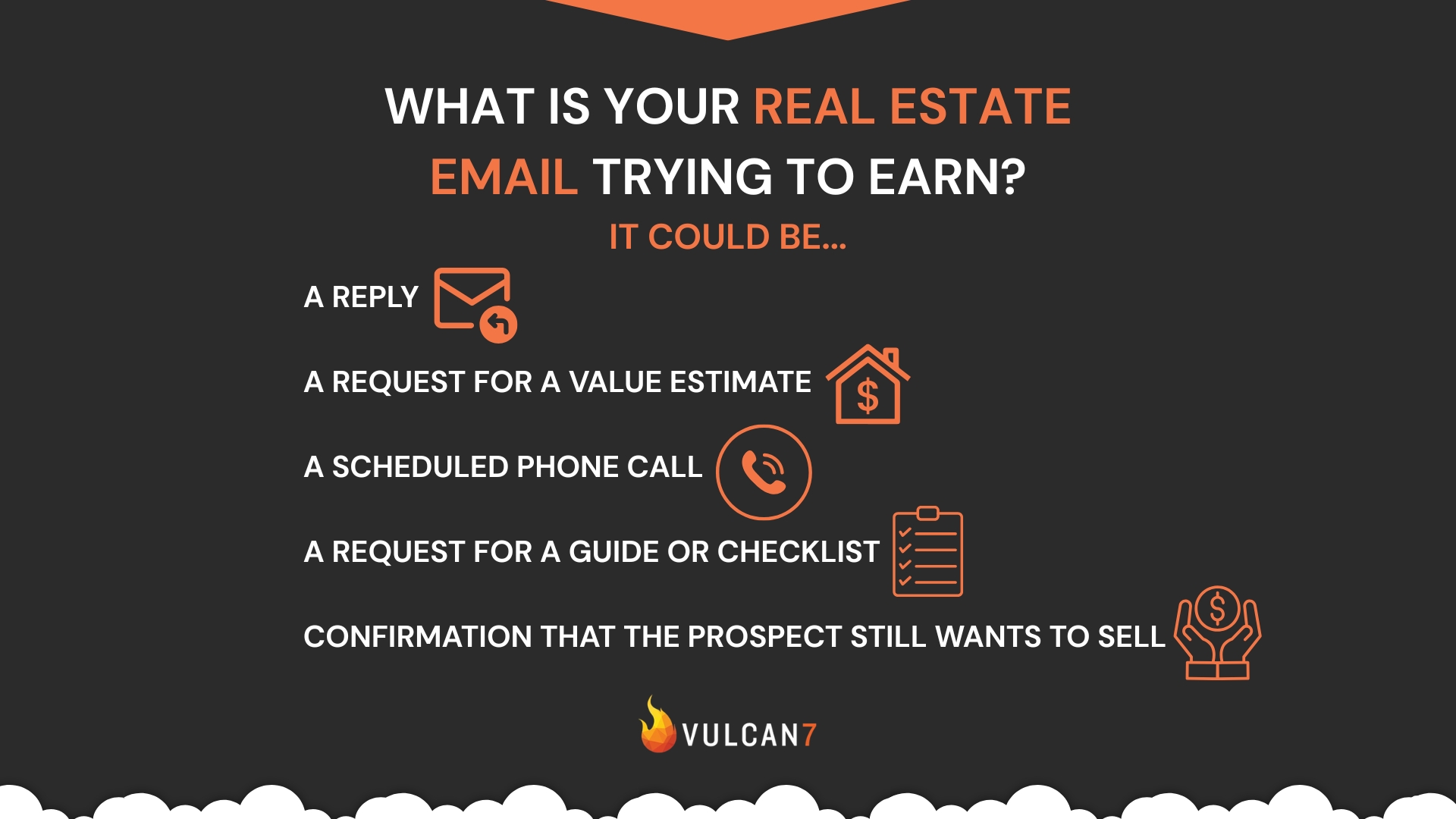
In most cases, you want a prospecting email to earn or lead to one of the following:
- A reply to the email
- A request for a value estimate
- Scheduling a short call
- Asking for a guide or checklist
- Confirming that the timing is right to sell
That means not every email needs to be long, flashy, or packed with links. In many cases, a shorter email with one clear purpose works better than a newsletter-style message full of competing calls to action.
Segment Your List Before You Write
The biggest mistake in real estate email marketing is treating every contact the same. An expired listing owner, a FSBO seller, and a neighborhood homeowner do not need the same message.
Segmentation makes your emails more relevant and gives you a much better chance of getting replies.
Common Real Estate Email Segments
-
- Expired listings: These prospects often feel frustrated, skeptical, or tired of hearing the same pitch. They usually need a message that shows empathy, credibility, and a clear plan. Learn how you can take more expired listings.
- Preforeclosure: These homeowners may be under financial pressure and dealing with a stressful, highly personal situation. Your emails should be respectful, calm, and solutions-oriented. Here are tips on how to find preforeclosure leads.
- FSBO sellers: These owners are trying to sell on their own. They may be motivated, but they do not necessarily want an agent unless they see a specific advantage. Find tips for success with FSBOs.
- FRBO owners and investors: These contacts tend to think in terms of numbers, time, and efficiency. Your emails should reflect that mindset. FRBO sellers can also be an excellent source of repeat business.
- Circle prospects: These are homeowners in a neighborhood around a listing, recent sale, or area you want to dominate. They may not be selling right now, so the goal is usually awareness and relationship building. Learn to master circle prospecting.
- Past clients and sphere: These emails should feel warmer and more personal. The focus is often referrals, repeat business, and staying visible.
Structuring Your Email Body
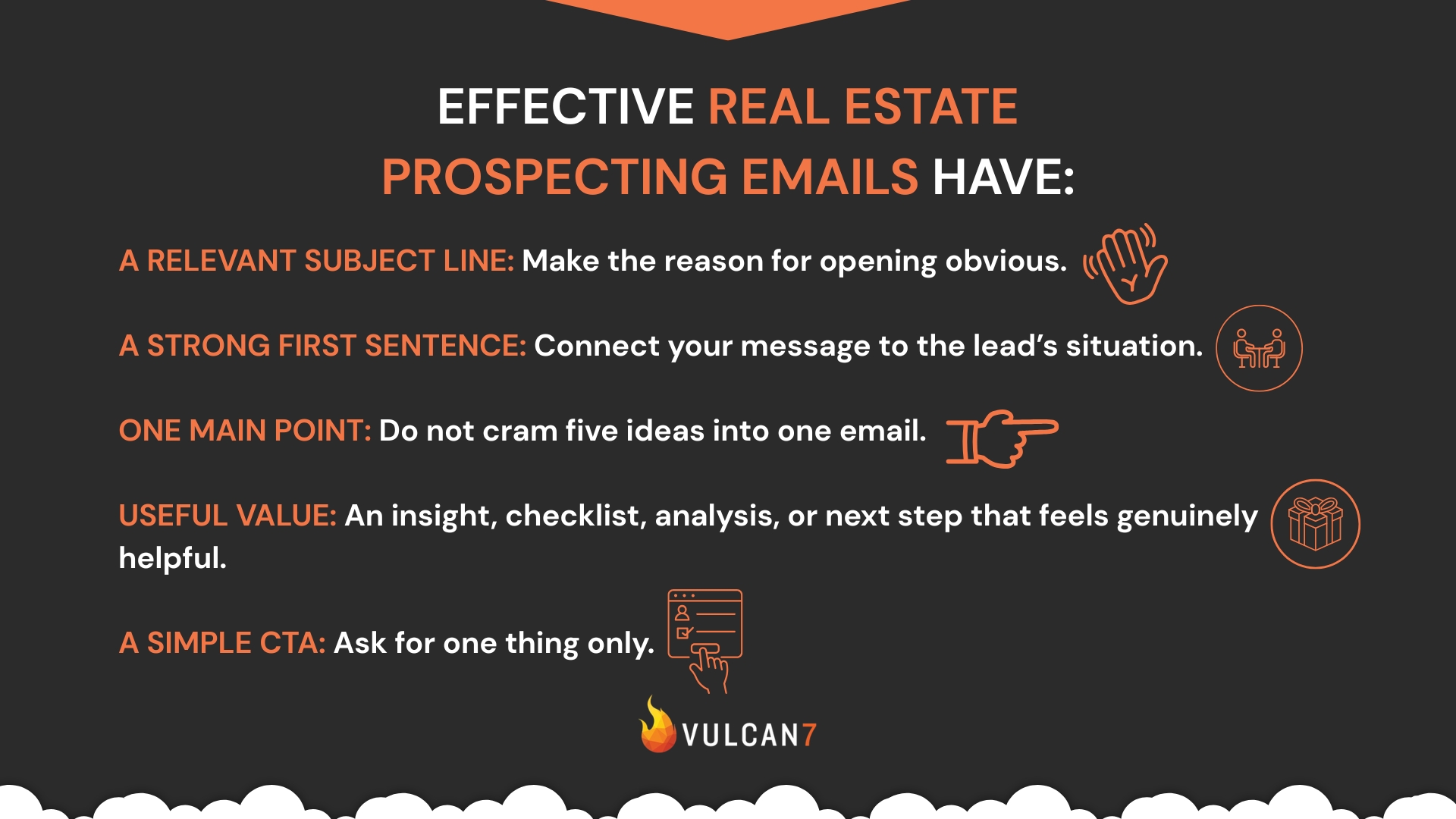
Most effective prospecting emails follow a simple structure:
- Relevant subject line: Make the reason for opening obvious.
- Strong first sentence: Connect your message to the lead’s situation.
- One main point: Do not cram five ideas into one email.
- Useful value: Offer an insight, checklist, analysis, or next step that feels genuinely helpful.
- Simple CTA: Ask for one thing only.
Nailing the Welcome Email
Remember, your first email sets the tone for everything that follows. If someone joins your list, downloads something from your site, or responds to your prospecting in another channel, the welcome email is your chance to make a strong first impression.
A good welcome email should do three things:
- Explain who you are
- Explain what kind of emails they will receive
- Make it easy to contact you
What to Include in a Welcome Email
- A short introduction with your name, market, and focus
- A sentence or two about how you help sellers or buyers
- What they can expect from your emails
- How often you plan to send them
- Your direct contact information
- A simple next step, like replying with a question or booking a call
What to Avoid
- A long autobiography
- Multiple competing calls to action
- Too many graphics
- Generic language that could apply to any agent in any market
Write Subject Lines That Earn Opens
The subject line has one job: get the email opened. It does not need to be clever. It just needs to feel relevant and compelling.
In real estate, subject lines often work best when they are:
- Specific
- Clear
- Short
- Personal
- Simple
- Connected to the recipient’s situation
Remember to avoid promotional language, which can make your email feel like spam. And don’t add fake urgency. If every email sounds like an emergency, recipients eventually stop believing you.
Examples:
- Quick question about your home on Maple Street
- A thought on why your listing may not have sold
- Still planning to sell on your own?
- Rental property question for you
- Curious if you have considered selling this year
Keep the Opening Personal and Direct
The opening lines matter almost as much as the subject line. Once someone opens the email, they should immediately understand why you are reaching out.
Avoid generic intros like “I hope this email finds you well.” That kind of filler wastes your most valuable space.
Instead, start with something grounded in the recipient’s situation.
Examples:
- I noticed your home recently came off the market, and I wanted to reach out with one thought.
- I saw you are selling without an agent, and I thought I would share something that may help.
- I have been working with homeowners in your area, and your neighborhood has been standing out lately.
- I work with local investors and rental owners, so I wanted to reach out with a quick question.
Match the Message to the Lead Type
Below is a practical framework you can use for different kinds of seller leads.
| Lead Type | Subject Line Examples | Opening Statement Example | Main Angle | Recommended Attachment or Link | Best CTA |
|---|---|---|---|---|---|
| Expired Listings | “A thought on why your home didn’t sell”
“Quick question about your expired listing” |
“I noticed your listing recently expired, and I know that can be frustrating after all the time and effort involved.” | Empathy, diagnosis, better plan | Relaunch checklist
Pricing adjustment overview Pre-listing improvement checklist Marketing plan sample |
“Would you be open to a 10-minute conversation about what I think could be improved?” |
| Preforeclosure | “A quick question about your options”
“You may still have time to explore solutions” |
“I know this may be a stressful time, so I wanted to reach out respectfully and share that there may still be options available.” | Empathy, urgency, clarity, solutions | Options overview
Timeline explainer Equity protection sheet Short guide to common next steps |
“Would it help if I sent a simple overview of the options homeowners often explore in this situation?” |
| FSBO | “Still planning to sell on your own?”
“One thing most FSBO sellers run into” |
“I saw you are selling on your own, and I wanted to share one issue many owners run into once showings and negotiations pick up.” | Help first, reduce friction, show value without a hard sell | Offer comparison worksheet
Seller net sheet Showing prep checklist Timeline for closing |
“If you want it, I can send over a quick pricing opinion or checklist.” |
| FRBO / Investor | “Quick question about your rental property”
“Have you considered selling this one?” |
“I work with owners and investors in the area, and I wanted to ask whether you are holding this property long term or considering a sale at some point.” | Efficiency, ROI, portfolio planning | Equity snapshot
Rent-vs-sell comparison Cap rate discussion sheet Local investor activity summary |
“Would it be helpful if I sent a quick value range and some recent investor activity nearby?” |
| Circle Prospects | “Your neighborhood is getting attention right now”
“A quick update for local homeowners” |
“I have been working in your area recently, and I wanted to share a quick update on what buyers are responding to in your neighborhood.” | Market education, local familiarity, top-of-mind awareness | Neighborhood sales update
Home value trend summary Seller readiness checklist Recent sold examples nearby |
“Would you like me to send a more detailed update on what homes near you are selling for?” |
Keep Your Emails Shorter Than You Think
Most prospecting emails should be concise. People skim. Long emails can work sometimes, especially for nurturing or educational follow-up, but your average outbound email should not feel like a blog post pasted into an inbox.
A good rule is to keep initial prospecting emails focused enough that the reader can understand the point in a few seconds. Use short paragraphs, cut filler and jargon, focus on one thing you want, and write the way you speak.
Using Images
Real estate is a visual business, but that does not mean every email should be image-heavy. Too many images can create formatting issues, slow load times, and make your message feel promotional instead of personal.
A text-first approach often works better for prospecting emails. If you do use visuals, make sure they support the message instead of overpowering it.
Good uses for visuals in real estate emails
- A simple branded header
- A clean local market chart
- A featured sold property example
- A one-page seller checklist or guide
Mistakes to avoid
- Giant image banners with little text
- Too many embedded photos
- Layouts that break on mobile
- Image-heavy emails with little or no context
Testing Your Emails Before Sending
This sounds basic, but it is one of the easiest ways to avoid embarrassing mistakes.
Send test emails to yourself before sending to your full list. Open them on mobile and desktop. Click every link. Make sure your formatting looks clean and your attachments load properly.
What to check before sending
- Subject line
- Preview text
- Spelling and grammar
- Contact name fields and personalization tokens
- Links
- Attachments
- Mobile formatting
- Unsubscribe link
- Signature and contact details
If you are sending to multiple segments, test each variation. A broken personalization field or wrong merge tag can make an email feel careless fast.
How to Avoid Looking Like Spam
Even legitimate agents can create emails that look spammy. Sometimes it’s the wording or formatting. Other times, it’s just sending untargeted messages to stale contacts.
Common signs of spam emails to avoid
- ALL CAPS subject lines
- Multiple exclamation points
- Overly promotional language
- Too many links
- Too many images
- Misleading subject lines
- Generic greetings with no personalization
- Sending to old or unengaged lists without cleanup
Your best defense against spam complaints is relevance. When people understand why they are getting your email and find it useful, they are much less likely to ignore it or mark it as junk.
Keeping Your List Clean
A clean email list performs better than a large messy one. If you have not emailed your database in a while, don’t assume everyone still wants to hear from you.
To clean your list, remove dead addresses, repeated bounces, and clearly inactive contacts. If you want to give people a chance to stay subscribed first, send a re-engagement email.
Related: How to Maximize Your Real Estate Database
Signs your list needs cleaning
- High bounce rates
- Low open rates
- Low click or reply rates
- Old leads with no engagement for months
- Duplicate contacts
- Contacts with incomplete or incorrect data
List hygiene best practices
- Remove addresses that bounce repeatedly
- Regularly suppress unengaged contacts
- Make unsubscribing easy
- Update names and tags where possible
- Separate active prospects from long-term nurture contacts
Developing an Email Cadence
A lot of agents either send too often with no strategy or disappear for months and suddenly send a blast. Neither approach works especially well.
Consistency matters more than volume. A predictable rhythm helps people remember who you are and prevents your emails from feeling random.
Real estate email cadence examples
| Cadence | Audience | Purpose |
|---|---|---|
| Weekly or biweekly | General nurture list | Share market updates, homeowner advice, seller education, and neighborhood insights |
| Based on activity and follow-up timing | Expired, preforeclosure, FSBO, and investor prospects | Send relevant outreach tied to listing status, selling activity, or investment signals |
| Monthly | Sphere and past clients | Maintain relationships, encourage referrals, and stay top of mind |
Giving People a Reason to Reply
Many real estate agents treat email like a one-way announcement channel. That is a mistake. Some of your best emails will look more like conversations than campaigns.
A reply is often a better outcome than a click.
Good reply-driven CTAs
- Are you still planning to sell this year?
- Want me to send over a quick pricing range?
- Would a short checklist be helpful?
- Are you holding this property or considering a sale?
- Want a quick breakdown of what buyers are paying right now in your area?
These feel easier and more natural than pushing every recipient toward a calendar link or long landing page.
Using Attachments and Resources
Attachments can add value, but only when they match the lead. Sending a generic PDF to everyone is not a strategy.
Think in terms of what would be genuinely useful to that specific contact.
Helpful resources by lead type
| Lead Type | Resources to Include or Offer |
|---|---|
| Expired Listings |
|
| Preforeclosure |
|
| FSBO |
|
| FRBO / Investors |
|
| Circle Prospects |
|
Tracking What Actually Matters
Open rates can still be useful, but they are not the whole story. For real estate email marketing, the most important metrics usually tie back to response and opportunity.
Metrics worth watching
- Reply rate
- Conversion to conversation
- Appointment rate
- Bounce rate
- Unsubscribe rate
- Re-engagement rate
- Performance by segment
- Performance by subject line type
The goal is not just “better email performance.” The goal is more real conversations with the right people.
Sample Email Frameworks by Lead Type
Expired Listing Email
Subject
A thought on why your home didn’t sell
Opening
I noticed your listing recently expired, and I know that can be frustrating after all the time and effort that goes into getting a home on the market.
Body angle
Share one or two credible reasons homes fail to sell, such as pricing, positioning, timing, presentation, or follow-up quality. Keep it practical, not critical.
CTA
Would you be open to a quick conversation about what I would change before relisting?
FSBO Email
Subject
Still planning to sell on your own?
Opening
I saw you are selling your home without an agent, and I wanted to share one issue that often catches owners off guard once interest starts coming in.
Body angle
Focus on a pain point like pricing strategy, negotiation pressure, time management, or legal paperwork. Offer a useful tool rather than a hard pitch.
CTA
If it helps, I can send over a quick checklist sellers use to avoid the most common issues.
FRBO / Investor Email
Subject
Quick question about your rental property
Opening
I work with local investors and rental owners, so I wanted to ask whether you are planning to hold this property or explore a sale sometime this year.
Body angle
Emphasize efficiency, equity, timing, and market conditions. Show that you understand the investor mindset.
CTA
I can send a simple value range and a few recent comparable sales if that would be useful.
Circle Prospect Email
Subject
A quick update for homeowners in your neighborhood
Opening
I have been working in your area recently, and your neighborhood is getting strong attention from buyers right now.
Body angle
Provide one local insight that matters, such as buyer demand, price movement, or low inventory.
CTA
Reply if you want a more detailed breakdown of recent sales near you.
Common Real Estate Email Marketing Mistakes
Even decent agents make these mistakes:
- Writing every email like a brochure
- Using the same message for every lead type
- Overdesigning emails instead of writing useful ones
- Sending too many links
- Ignoring mobile formatting
- Failing to test sends
- Keeping dead contacts on the list
- Not following up after an initial email
- Trying to sound overly polished instead of human
- Making every CTA too big or too demanding
A Better Mindset for Real Estate Email Marketing
The best real estate email marketing does not feel like mass marketing. It feels timely, useful, and specific.
That means your goal is not to impress people with design or flood them with content. It is to show up with the right message at the right time in a way that makes replying feel easy.
When you segment your database, write with a clear purpose, keep your list clean, and make each email feel relevant to the lead type, email becomes much more than a routine touchpoint. It becomes a practical way to build trust, start conversations, and generate more opportunities from the contacts you already have.
Vulcan7’s real estate prospecting platform is full of features that can help you make meaningful connections with more leads, manage your pipeline efficiently, and close more deals. Request more information today and see how we can take your email marketing to the next level.

Ready to Get Started?

Share the Secrets
Still Have Questions Or Interested In Learning More? Contact Us Today
RECOMMENED ARTICLES

How to Approach an FSBO as a Realtor [with Scripts]
Summary To approach an FSBO as a realtor, start by…

How to Win the Highest-Opportunity Days of the Year: Inside the Vulcan7 Real Estate Prospecting Bootcamp
Every year, thousands of real estate listing contracts expire at…

What to Do After Closing: Best Tips for Cultivating Customer Relationships in Real Estate
You handed over the keys, wrapped up the paperwork, and…